
Omni-Optimizer#
The Omni-Optimizer [7] is a generic evolutionary algorithm that is able to solve single- and multi-objective problems with one or many (equivalent) optima. It is based on NSGA-II but introduces three modifications that make it particularly effective for multi-modal multi-objective optimization, i.e. problems where several distinct regions in the decision space map to the same (or an equivalent) region of the Pareto front.
Key Components#
Dynamic ε-dominance: The non-dominated sorting uses a loose dominance relation. A solution only dominates another if it is better by more than a margin of delta * epsilon_j in at least one objective, where the per-objective epsilon_j is computed dynamically as the range of objective j in the current population. Solutions that are very close in objective space are therefore placed in the same front.
Crowding distance in objective and variable space: In addition to the usual objective-space crowding distance, a crowding distance is also computed in the decision (variable) space. For each solution, the larger of the two values is used whenever the solution is less crowded than the population average in either space, and the smaller one otherwise. This rewards solutions that are diverse in the decision space and is what allows the algorithm to keep equivalent solutions that would collapse under NSGA-II.
Restricted nearest-neighbor mating: Instead of pairing two random solutions, each binary tournament is held between a randomly selected solution and its nearest neighbor in the (normalized) decision space. This biases recombination towards solutions of the same basin and helps to preserve distinct optima.
Setting var_crowding=False essentially recovers NSGA-II, while delta=0 disables the loose dominance and recovers the usual Pareto dominance.
Example#
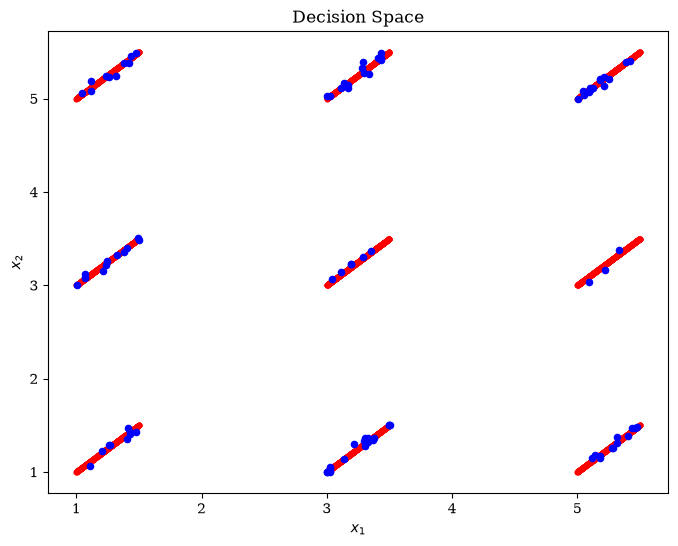
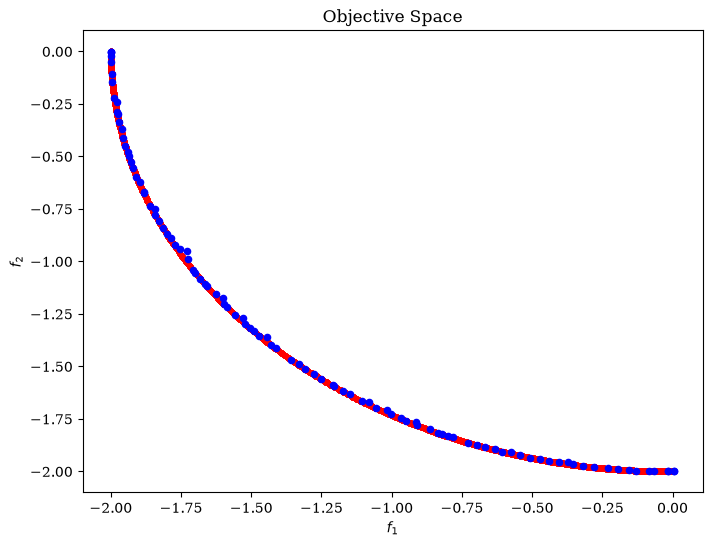
The OmniTest problem has 3^n_var equivalent Pareto subsets in the decision space that all map to the same Pareto front. The Omni-Optimizer is able to find and maintain (almost) all of them.
[1]:
from pymoo.algorithms.moo.omni import OmniOptimizer
from pymoo.optimize import minimize
from pymoo.problems.multi.omnitest import OmniTest
from pymoo.visualization.scatter import Scatter

problem = OmniTest(n_var=2)

algorithm = OmniOptimizer(pop_size=100)

res = minimize(problem,
               algorithm,
               ('n_gen', 200),
               seed=1,
               verbose=False)

plot = Scatter(title="Decision Space", labels="x")
plot.add(problem.pareto_set(5000), s=10, color="red", label="Pareto set")
plot.add(res.X, s=20, color="blue", label="Obtained solutions")
plot.show()
[1]:
<pymoo.visualization.scatter.Scatter at 0x7a613e537e10>
[2]:
plot = Scatter(title="Objective Space")
plot.add(problem.pareto_front(5000), s=10, color="red", label="Pareto front")
plot.add(res.F, s=20, color="blue", label="Obtained solutions")
plot.show()
[2]:
<pymoo.visualization.scatter.Scatter at 0x7a613cbb0050>
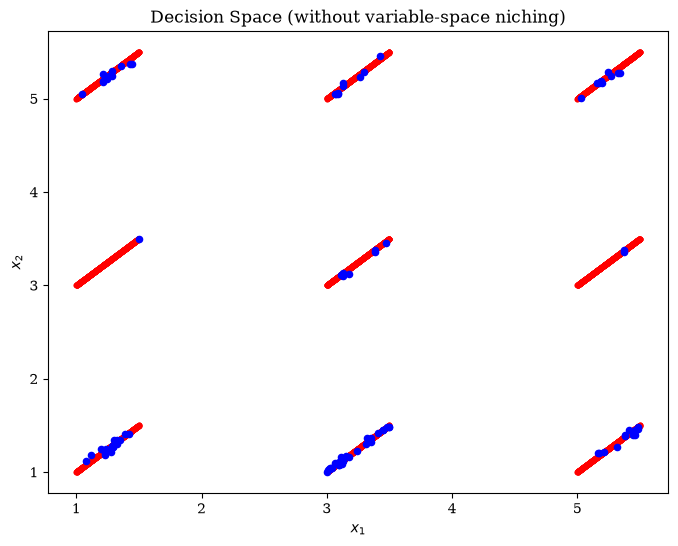
The effect of the variable-space niching becomes clear when it is disabled (var_crowding=False), which niches only in objective space and essentially recovers NSGA-II: the equivalent subsets collapse onto only a few of them.
[3]:
res_no_var = minimize(problem,
                      OmniOptimizer(pop_size=100, var_crowding=False),
                      ('n_gen', 200),
                      seed=1,
                      verbose=False)

plot = Scatter(title="Decision Space (without variable-space niching)", labels="x")
plot.add(problem.pareto_set(5000), s=10, color="red", label="Pareto set")
plot.add(res_no_var.X, s=20, color="blue", label="Obtained solutions")
plot.show()
[3]:
<pymoo.visualization.scatter.Scatter at 0x7a613c6eec90>
Customization#
Because the Omni-Optimizer is a regular genetic algorithm, several extensions are simply different compositions of existing pymoo components and require no change to the algorithm. For example, the crossover operator can be swapped in a single line (e.g. OmniOptimizer(crossover=PCX())).
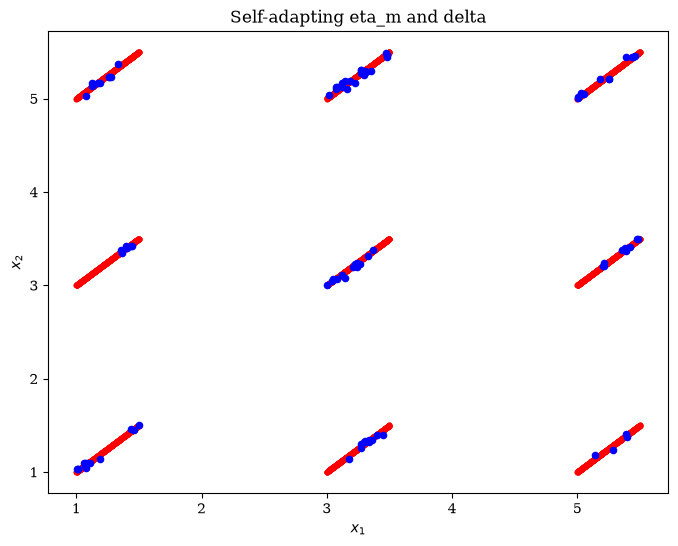
More elaborate ideas, such as adapting the parameters over the course of a run, can be implemented with a Callback. The following one increases the polynomial mutation index eta_m (for finer mutations towards the end) and decreases the loose-dominance margin delta (to progressively tighten the fronts), all without modifying the algorithm.
[4]:
from pymoo.core.callback import Callback


class ParameterControl(Callback):

    def __init__(self, n_max_gen, eta=(20.0, 100.0), delta=(1e-2, 1e-4)):
        super().__init__()
        self.n_max_gen = n_max_gen
        self.eta = eta
        self.delta = delta

    def notify(self, algorithm):
        t = min(1.0, (algorithm.n_gen or 1) / self.n_max_gen)
        # increase the polynomial mutation index eta_m (linear)
        algorithm.mating.mutation.eta.set(self.eta[0] + t * (self.eta[1] - self.eta[0]))
        # decrease the loose-dominance margin delta (geometric)
        algorithm.survival.nds.dominator.delta = self.delta[0] * (self.delta[1] / self.delta[0]) ** t


n_gen = 200
res = minimize(problem,
               OmniOptimizer(pop_size=100),
               ('n_gen', n_gen),
               seed=1,
               callback=ParameterControl(n_gen),
               verbose=False)

plot = Scatter(title="Self-adapting eta_m and delta", labels="x")
plot.add(problem.pareto_set(5000), s=10, color="red", label="Pareto set")
plot.add(res.X, s=20, color="blue", label="Obtained solutions")
plot.show()
[4]:
<pymoo.visualization.scatter.Scatter at 0x7a613cd29b10>
API#
- class pymoo.algorithms.moo.omni.OmniOptimizer(self, pop_size=100, delta=0.001, obj_crowding=True, var_crowding=True, sampling=LHS(), selection=NeighborBasedTournamentSelection(func_comp=binary_tournament), crossover=SBX(eta=20, prob=0.8), mutation=PM(eta=20), survival=None, output=MultiObjectiveOutput(), **kwargs)[source]
Omni-Optimizer: a generic evolutionary algorithm for single/multi-objective optimization.
Proposed by Deb and Tiwari (European Journal of Operational Research, 185(3), 2008, pp. 1062-1087) for single- and multi-objective, single- and multi-global optimization. It is an NSGA-II based algorithm with three distinctive components:
a non-dominated sorting based on a loose epsilon-dominance whose epsilon is calculated dynamically from the population (
LooseDominator),a crowding distance computed in both the objective and the variable space (
calc_omni_crowding_distance()), anda restricted binary tournament selection between a solution and its nearest neighbor in the decision space (
NeighborBasedTournamentSelection).
These components allow the algorithm to find and maintain multiple equivalent Pareto-optimal solutions, i.e. solutions that map to (almost) the same point in objective space but are distinct in decision space.
- Parameters:
pop_size – The population size.
delta – The epsilon margin (as a fraction of each objective’s range) used for the loose dominance.
delta=0recovers the usual Pareto dominance.obj_crowding – Whether to niche in the objective space.
var_crowding – Whether to niche in the variable space. Disabling it essentially recovers NSGA-II.
sampling – Sampling operator (defaults to the operator from the original paper).
selection – Selection operator (defaults to the operator from the original paper).
crossover – Crossover operator (defaults to SBX, as in the original paper).
mutation – Mutation operator (defaults to polynomial mutation, as in the paper).
survival – Survival operator (defaults to
OmniOptimizerSurvival).output – Display output used during the optimization run.
**kwargs – Additional keyword arguments passed to the genetic algorithm base class.
Acknowledgement#
The Omni-Optimizer implementation in pymoo was contributed by evanroyrees, faithfully following the reference implementation of the original authors (Deb and Tiwari, 2008).
Thank you for the contribution — pymoo grows through community contributions like this one.